Wednesday, September 10, 2014

Rus

D&D got me interested in history at a young age, and I love running quasi-historical campaigns. I say quasi-historical because I like including lots of folklore, and I'm not trying to run something 100% historically accurate, because that's too much to keep track of and nobody would really care anyway.

I ran a Celtic game based heavily off the Slaine comics and their vision of prehistoric Britain. At one point the group time-travelled to sub-Roman Wales and joined Arthur and some of his knights (notably not Lancelot, who was a later invention) against Mordred, even killing the traitor themselves. I looked up a lot of Welsh mythology, including the oldest Arthur legends. They have been added to so much over the years that the original legends are vastly different.

Perun
Anyway, I recently remembered the Russian storm god Perun and decided to look him up. Turns out he's THE good god of the mythology. He takes the form of an eagle and sits on an oak that connects the whole world. He wields thunder and lightning as weapons, and is the lord of sky and war. He's like Zeus and Thor in one god. In the roots of the above oak tree is Volos, a horned serpentine being who gnaws at the tree and is frequently put in his place by Perun. He is also the god of the underworld, wealth, magic, and music. So he's Hades and Loki, not all evil but associated with a lot of dark things. I thought that was a great simple mythology for a game world.

The idea took root. I'd love to play a setting that was more Russian/Slavic influenced than the typical Western European-style medieval world. I tend to go towards Britain-style fantasy, but that always leads me to a more primitive Celtic world. That's just where my mental rails go. There's lots of cool medieval weirdness that's associated with a later time period, and I could mix that with a Slavic setting and keep the pagan bits, because that area converted fairly late, around the 8th-11th century. That's also when the viking were ravaging Europe, including parts of Russia (the name actually comes from the word "Rus", used to describe the foreign pirates--they became the ruling class).
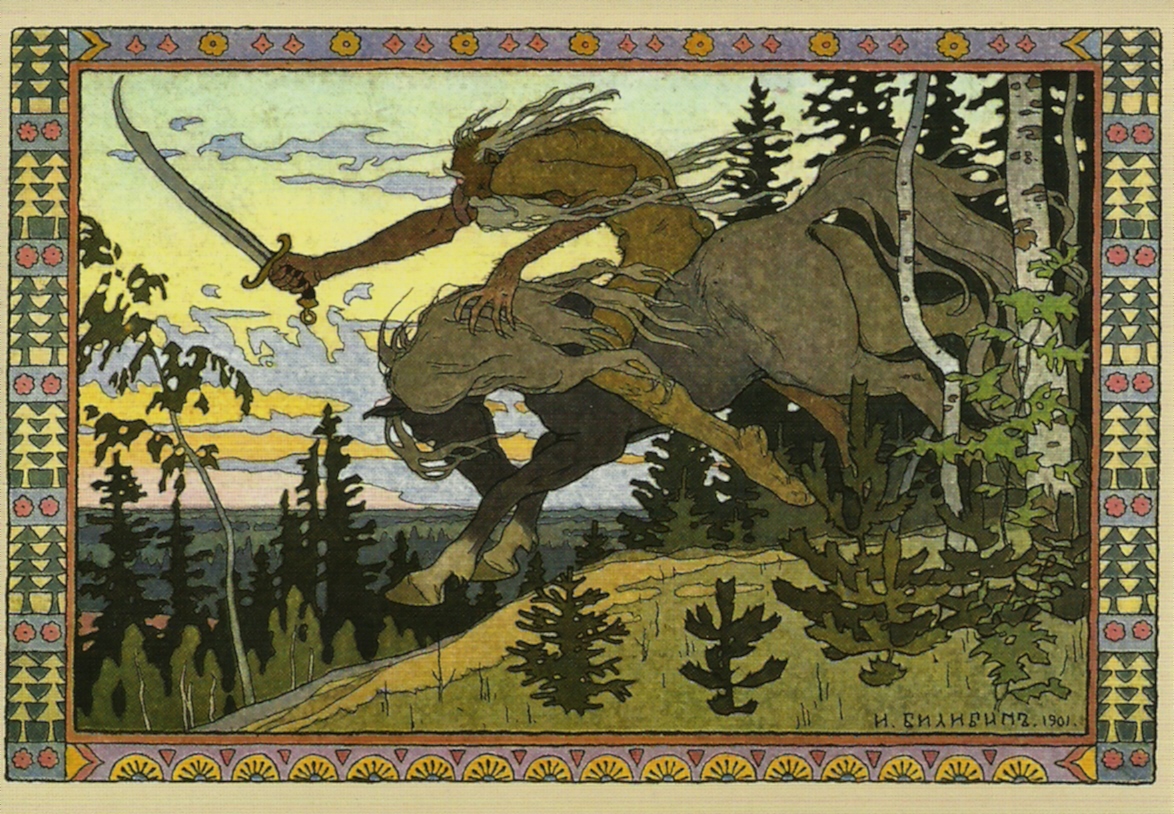

Koschei the Deathless, warrior lich
So here's broad strokes: Russian and Eastern European legends, dark forests and mountains, vampires and werewolves, a christian-style church that's mostly popular with the nobility, peasants who pay lip service to the church while still honoring the old ways openly, any elements of medieval life and folklore I can shoehorn in. I'm not even sure about system, I'd love to do more Dungeon World but its got so much flavor built into the classes that sometimes it doesn't fit a setting. I'm a little over D&D on the other hand, and people tend to bring their system assumptions with them.

I spoke recently that a setting needs to be compelling. It has to draw the characters into adventure. I'm thinking using 13th Age's icons as inspiration, and coming up with several powerful characters that can influence the setting. The Midgard setting from Kobold Press has articles on icons for that setting, including the Baba Yaga. I'll use that for some inspiration. 

Baba Yaga, making a skull lantern
Influences--Hellboy, Dracula, Slavic mythology, Vampire (Tzimisce, Nosferatu), Werewolf (Silver Fangs, Shadow Lords), Midgard setting, Ravenloft setting (Barovia, Vistani), Hemlock grove, Codex Slavorum (not out yet!), Stravinsky

Characters/Monsters--Baba Yaga, vampires, werewolves, gypsies, Koschei the deathless, firebird, zmey (dragon), domovoi (house spirit), likho (bad luck goblin), vodyanoy and rusalka (mermen and women)


Monday, September 8, 2014

Overthinking & Observations

Random thoughts:

There are lots of things I don't like about D&D, but its still my favorite game.

I go with generic too often, I should go for specific, stylized, or even silly. Reading more will help with this. My next cleric NPC is going to be like one of the priests in Cornwell's Agincourt book--a rude soldier who praises god while demeaning his enemies, who lazily makes the sign of the cross while drinking ale.

I need ideas I get excited about, so I get excited while running the game, so the game is more fun and energetic.

A panel I saw at Dragon Con got me excited about world building. One thing I took away was that cause and effect is the biggest contributor to making the world seem realistic and alive. One thing from reading some good historical fiction lately is that its all the interactions between people that make the world interesting. Again, I tend to go for a generic feel sometimes, but a viking chief that stands out is more compelling than trying to represent an accurate depiction of a typical viking chief.

That word COMPELLING. Setting should be. NPCs should be. Adventures should be.

Another panel about the Cthulhu Mythos and gaming reminded me to put more weird shit in my games. I flipped through Monte Cook's Chaositech book, the Wyrm stuff from Werewolf: the Apocalypse would work too.

By the way, Lovecraft was a huge racist. Visionary horror/sci-fi author, but a horrible man in that regard.

I saw Monte Cook twice, was able to speak to him briefly too. I was a big Monte Cook fanboy during 3E, I played Arcana Evolved and Call of Cthulhu d20, and I've tried running Return to the Temple of Elemental Evil twice (I think I need to strip it down to play it--I like the Celtic twist I had for it a while back).

I also saw Tracy Hickman, who's most known for Dragonlance but also helped write I6: Castle Ravenloft, my favorite adventure of ever. Also met Kenneth Hite, who wrote the Qelong adventure I'd still like to run (and also helped write Call of Cthulhu d20).

I went to the D&D Trivia event at Dragon Con, and ended up winning. I feel super nerdy for accomplishing this, and then I feel bad for being ashamed of my geekiness.

I went to an Irish pub with my wife during the Con and ended up sitting next to two other guys who had also just come from the world building panel. We talked about D&D games over beers and food, that was a cool experience.

Speaking of my wife, we make a good barbarian couple.


Wednesday, August 13, 2014

#RPGaDay, part 1-13

...or like, a couple times a month.


I kept getting confused why the RPGA was having a Day, and why it seemed to happen multiple days. I can be kind of thick sometimes.

I'm no good at blogging regularly, so here's short answers for the month so far.

1st - First RPG Played
Still torn between Fianna and Shadow Lords
The D&D Red Box had a solo adventure I played in middle school. I think the first time somebody else actually ran a game I played in was Werewolf: The Apocalypse in high school.
2nd - First RPG Gamemastered
D&D Red Box, probably for family members.
3rd - First RPG Purchased
With my own money? Either some D&D 2E supplement or Werewolf.
4th - Most recent RPG purchase
I just bought some DCC adventures. They're awesome.
5th - Most Old School RPG owned
Wow...Hulks & Horrors? There's so many retro-clones its hard to say.
6th - Favourite RPG Never get to play
I didn't get to play much 4E D&D, and there were some awesome character concepts I wanted to try.
7th - Most “intellectual” RPG owned
Mage: the Ascension. Every spell is a philosophy discussion.
Warp drive is created by space slugs having
sex, but not if anyone's watching.
8th - Favourite character
Eodrid, the Grey Elf Oracle of Pelor.
9th - Favourite Die / Dice Set
I'm playing more dungeon world, so my d6's with cthulhu symbols for "ones" are neat.
10th - Favourite tie-in Novel / Game Fiction
I've never much cared for official rpg fiction, though the Warhammer 40k stuff interests me a bit. I'd rather read the "Appendix N" books that inspired the game to begin with, and historical/pseudo-historical fiction for inspiration.
11th - Weirdest RPG owned
HOL, or the homebrew game system where I played a Werewombatman.
12th - Old RPG you still play / read
Marvel Super Heroes. Its a surprisingly elegant system, and by far the best superhero rpg I've come across.
13th - Most Memorable Character Death
The first one that comes to mind (which by definition makes it the most memorable) was my Storm Cleric facing down a dragon in D&D Encounters. I was low on hit points already when I saw my chance to take him down. I turned to my fellow adventurers and said, "Gentlemen, its been an honor and a privelege." Then I charged with my spear.

I want to play. Lets play.

I came across this post from Robert J. Schwalb that discussed his relationship to D&D. My main takeaway is this bit:

So with all that love, I’m left wondering what the problem is. In suspect it’s that for the last 15 years or so, the most important part of the game has not been playing but rather creating for it. Character creation used to be something you had to do before you could have the fun. The mechanics were the necessary evil, the gauntlet you had to run. In recent years, the fun has moved from the time you spent at the table to the time you spend thinking about the table. Sure, back in the old days, I made plenty of characters for games I played and games I wanted to play but never really did. It was just like doing math problems. They had solutions. You just had to roll the dice, make the choices, and plug the information into the sheet. But hasn’t been that way for a while.

It seems the fun for many is in putting the different pieces together to create something new. Clever play now occurs in isolation. The player earns the greatest reward not from having a good idea at the table or thinking to look behind the wardrobe and finding a magic item, but from the discovery of a winning combination of mechanics, the perfect marriage of two spells, skill and feat, class feature and widget. The pleasure comes from realizing the broken combination and from putting the mechanical abomination into play. No delight is sweeter than that which is experienced by watching the expressions of those who must bear witness to your creative horror. Does it matter that the loophole makes the game unplayable? Does it matter that such shenanigans immediately put the beleaguered Dungeon Master on the defensive, to the point that he or she flails because the game no longer seems to work? Not at all. Why? Because the game wants you to break it. It begs for you to dig in and explore the options. The endless parade of new mechanics demand you to pick them up, peer at them in the light, and plug them in. It’s a game made for the tinkerers. Oh, you just want to play? Well, you’ll need these ten books, this character generation tool, and on and on and on.

The prize for being the best player goes not to the creative mind, the cunning tactician, the burgeoning actor, but to the best mathematician. Perhaps this was the way it was doomed to go. The seeds were there all along. The mechanical-minded played spellcasters—who dominated—while the rest plodded along with fighters. As the game evolved, it was no longer sufficient for the fighter to become more accurate or to attack more often: the fighter had to do things beyond swing a sword or loose an arrow from a bow. The game needed rules for every situation, for every scenario, and with each new rule came a new exploit, a new opportunity to bend the game into something terrifying.


This is what I mean when I say I have a different play style than a lot of gamers I meet. I want to play more than create. I love world building, but I've discovered I'd rather have some cool ideas to fill in questions as they come up in play, rather than a completely detailed setting like an encyclopedia. By the same token, I only care about what your character does in the session, not his backstory. Dungeon World has taught me a lot about how to integrate this into the game as you play. Asking a few questions here and there helps flesh out a character very naturally.

I've said it before, it only matters if it comes up in play. 

Dark Lanterns: Dragon me Down


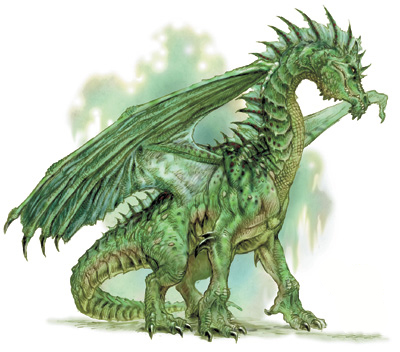
The most iconic looking dragon breathes...chlorine gas?
This session was a while back, the write-up has been sitting around waiting on me. One of our players had a change in his work schedule and a new player joined, so it looks like we'll be playing a new campaign instead of continuing this one for now. More on that later. So what happened in the Return to the Temple of Elemental Evil last time?

One of the cool things about the Crater Ridge Mines, which is the majority of the adventure, is that its a giant ring with two gates, so there's lots of options in terms of where to go. Rather than keep pushing past the Earth temple, the group decided to go the other direction and follow some mine cart tracks.

One side tunnel had some chewed on statues, petrified gnolls. A cautious scouting attempt confirmed that it was a basilisk, and they closed the tunnel off with a Wall of Stone.

Near the end of the tracks, the party was attacked by a green dragon. It got off one breath attack before the ninja goblin got it pinned with repeated Stunning Fist attacks. Checking out the dragon's lair, a fiendish girallon was summoned as a protector. It really tore into the ranger, but was put down.

No shit. Seriously, read a book sometime.
I had mixed feelings about this session. The players felt threatened, which hasn't happened much, but they still took down everything fairly easily. The basilisk was bypassed, the dragon was stunned most of the fight, and the girallon only got close because the ranger elected not to trip attack with its chain for some reason. I'm usually a big fan of player's defeating a threat through smart play, but honestly I was really bored most of the session. The girallon fight was the most fun, and that was just a back and forth slugfest.

Monday, July 28, 2014

Dark Lanterns: Xorn Scorn

We're playing Return to the Temple of Elemental Evil again for the first time in a couple of weeks and I never recapped the last session.

The big fight against the Earth Temple wasn't a huge challenge but wasn't a cakewalk either. One of the side tunnels before the temple had a group of centipedes that were labeled as the pets of one of the evil clerics. The party ninja tried luring the bugs to fight the temple, but I figured since they were pets of the temple they wouldn't attack, but they didn't add much to the challenge of the fight either. It didn't really become an issue, but here's another weird thing about 3rd Edition. The ninja player's reasoning on luring the bugs out was "they're Vermin, they can't be controlled", and when they didn't attack the bad guys another player said "he must be a Vermin Lord." 3rd edition is incredibly Simulationist. Everything has an internal logic, and while that can be cool at times, at other times it can derail a DM's idea. The NPC cleric didn't have a prestige class to control Vermin (which is a game term for the Type of monster, not a generic word), I just decided he wouldn't be attacked by his own pets.

The only thing that kept the fight interesting was that the players split up to take down different threats instead of piling up on one at a time. One cleric went down right away, but the second troglodyte cleric was incredibly buffed up by magic and was tougher to take down, and the chain fighter was having trouble fighting a Xorn that did lots of damage.

After the head cleric and most of the trog cultists were killed the Xorn disappeared. The group decided to sleep in the temple and I wasted too much time checking if the Xorn could coup de grace a sleeping PC. I need to just start playing looser and faster, and hope the playstyle works. One of the weeks when we couldn't get everyone together we played a Dungeon World one shot using a Dungeon Crawl Classics adventure. I felt like we got a lot more play in that one session, even with creating 3 "0-level" characters per player. I need to crib more playstyle stuff from Dungeon World.

Another thing is I need to modify the adventure a bit to be more challenging. I was loathe to change much because this was a flagship adventure for the release of 3rd Edition, but I'm playing with three optimizers and they're plowing through some of these encounters. I don't think the Earth Temple was designed with an Enlarged chain fighter in mind. More ranged combat and some thought to tactics will help, I think.

Wednesday, June 25, 2014

Dark Lanterns: you CAN keep a bad trog down

We've been playing the 3E Return to the Temple of Elemental Evil adventure for a few weeks now. So far the group has uncovered cultists of the Elder Elemental Eye (Tharizdun) around Hommlet, and found the Temple of All-Consumption in the northern mountains. All the PCs are agents of the Dark Lanterns, the espionage branch of kingdom of Breland. Everyone is stealthy and has a licence to kill.

We met at a player's house this time instead of my place because I didn't feel like cleaning a bunch of stuff and kicking my wife out of the front room for the evening. Everyone was a little late but we started fairly quickly. I decided to bring just the bare minimum of books needed, and I took the time to go through my minis and counters for everything that might come up for the whole adventure. I just dumped everything out of my stormtrooper lunch box onto my carry bag and was able to grab what I needed fairly easily as it came up.

The group had made their second attack on the main gate last week, where they finished off the reanimated guards from the first attack and the troglodyte cleric who commanded them. They decided to head North in the caves, towards the Earth temple. This part of the temple is a series of mines and caves in the rim of a volcano that blew its top a long time ago.

The goblin assassin scouted ahead as usual, but failed to get a death attack on a large troglodyte wielding the Sword of Earth. The trog called a cleric and an earth elemental from an adjoining cave while the assassin PC went down another hallway, eventually luring some trog mooks to join the fight. The spiked chain ranger dominated the battlefield like he always does, tripping everything within his Enlarged reach.

The fight reminded me of one of my 3E pet peeves--the sheer number of modifiers and attention to petty details. I liked how 4E had combat advantage, and multiple conditions didn't make it stack. Sure, its more "realistic" that being prone AND flanked makes you that much easier to hit, but on the other hand we have a 10' tall elf with a 20' spiked chain in a 10' wide hallway where he can attack anybody with no penalty. Sure, that's realistic.

Also, at one point I had the earth elemental try to push the chain fighter back to give his allies some time to get up, and it was a mess of multiple checks, "does he have the +4 from the correct feat?" (because gods forbid the monster wasn't built properly), and debating whether he would provoke an Attack of Opportunity from a different combatant...all so the elemental could spend his whole turn pushing someone 5 feet and not dealing damage! In 4E it would have been Damage + push one square and move on.

I'm trying not to let all this get on my nerves too much, but its obviously bothering me a little bit. Part of it is just that I feel like I have no control as DM because every detail of combat has a specific, overly complicated rule and everyone knows the rules inside and out. I can't just make a judgement call and keep things moving quickly, and it becomes draining.

We were still able to do more than just one big fight, as a manticore was dispatched fairly easily by the ranger who just joined the group. An earth mephit was likewise quickly taken out, and we wrapped the game up there. I've been having allergy issues, and I didn't want to try to push on through the sinus headache that was building at the end of the night.

I think we have a fundamental difference in playing styles that's causing me some frustration, but I think I can get over it. I need to prep more to keep things moving faster on my end, and that will also help me challenge the PCs more. Right now everything's been a cake walk. Really, the "toughest" part of any of the fights has been hitting the NPCs, as trog clerics in full plate have ridiculous armor classes.

The big Earth Temple fight is coming up soon, that should be interesting.